Site Analysis Service

Land is not a blank surface. It operates as a system of forces, constraints, and measurable limits.

Contours affect grading cost. Soil layers influence foundation design. Drainage paths determine water control strategy. Access points shape logistics planning. Regulatory boundaries restrict buildable area. Each factor impacts structural stability, construction budget, approval timelines, and long term asset performance.

When you ignore these variables, projects face foundation redesign, waterlogging, infrastructure overload, and capital escalation.

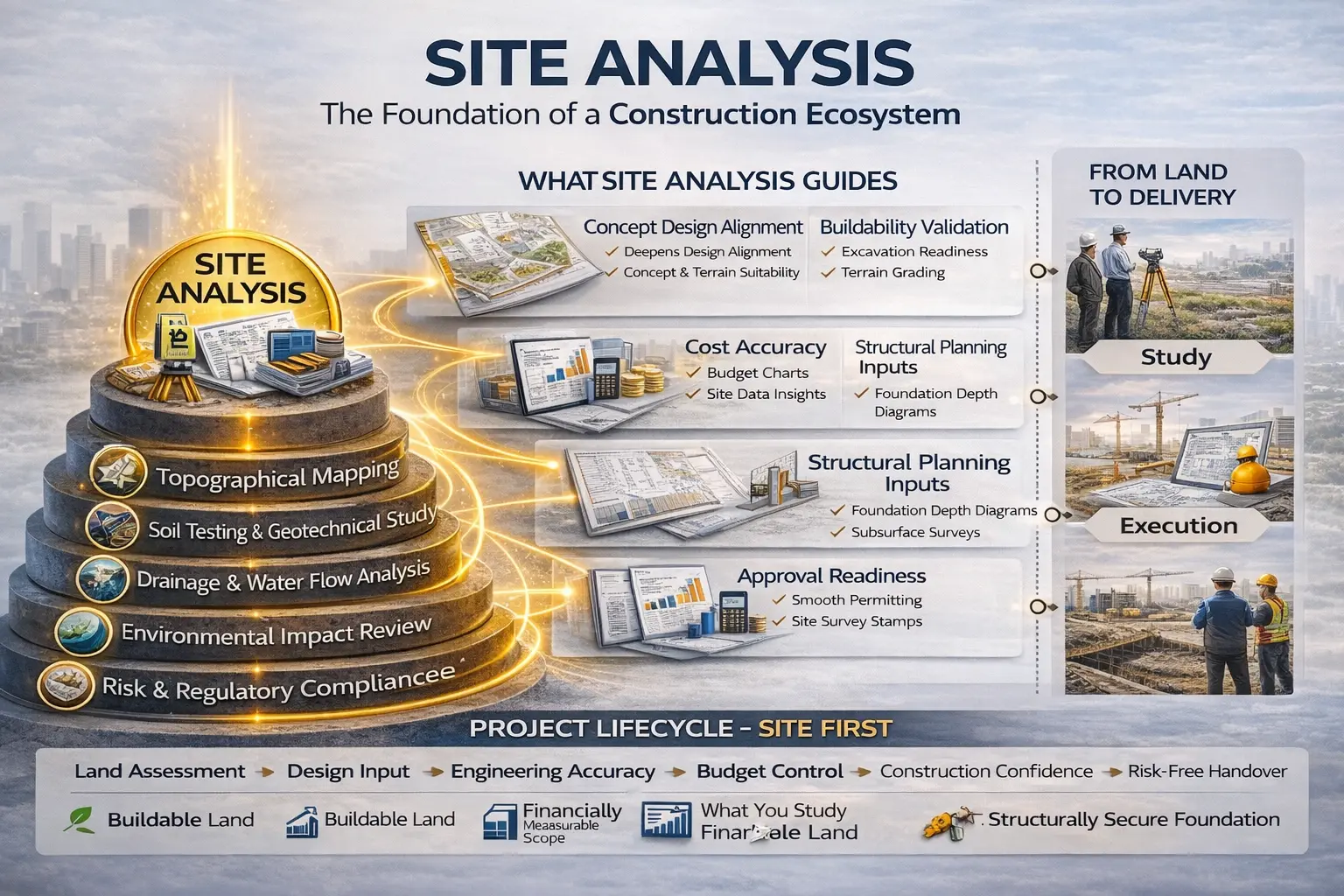
Our Site Analysis Services convert raw land into structured development intelligence. We study topography. We validate soil strength through geotechnical data. We map drainage flow. We assess infrastructure capacity. We evaluate zoning and environmental controls before design begins and before you deploy capital.

This process relies on engineering data, not surface observation.

As an ecosystem driven construction partner, we connect site analysis directly with feasibility studies, master planning, structural systems, budgeting, and execution sequencing. Each insight informs a buildable strategy.

We do not observe land conditions in isolation.

We define what your site supports in structural, financial, and operational terms. Ground level certainty determines performance at every level above.
Why Site Analysis Services Are Important

site analysis services

Without proper site analysis, your project carries hidden risk. Structural instability increases. Waterlogging affects foundations. Poor orientation reduces energy efficiency. Regulatory rejection delays approvals. Infrastructure overload disrupts operations. Design inefficiencies inflate cost.

Site Analysis Services provide measurable clarity at the ground level. We deliver topographical mapping, soil validation, drainage flow analysis, regulatory alignment, infrastructure capacity review, environmental risk identification, and buildability confirmation.

You replace assumption with verified data.

  • For developers, you protect capital from early stage miscalculation.
  • For architects, you design with correct orientation and site logic.
  • For engineers, you validate structural feasibility before detailing.
  • For investors, you strengthen long term asset confidence.

Development begins with certainty when land intelligence leads the process

What Our Site Analysis Services Include

Our Site Analysis Services follow engineering logic, regulatory clarity, and execution focus. You get structured evaluation at every layer of the land. You reduce uncertainty before design begins. You protect capital before construction starts.

Topographical and Contour Analysis

We assess site elevations, slopes, and terrain gradients. You understand how the land behaves under load. Contour mapping guides foundation planning, basement feasibility, and cut and fill calculation. You reduce excavation cost through accurate grading strategy. You prevent long term structural stress caused by uneven settlement.

Soil Investigation and Bearing Capacity Assessment

We conduct geotechnical testing to measure soil composition, safe bearing capacity, settlement behavior, and groundwater levels. You select the correct foundation type based on data. Shallow footing suits stable strata. Raft supports distributed loads. Pile foundation transfers load to deeper layers when required. You avoid structural failure and expensive correction after construction.

Drainage and Water Flow Evaluation

We study natural water movement across the site. You identify low lying zones and runoff direction. We assess rainfall discharge capacity and stormwater planning routes. Proper drainage planning prevents foundation weakening and waterlogging. You protect waterproofing systems and structural durability over decades.

Access, Connectivity and Mobility Assessment

We evaluate road width, entry and exit feasibility, turning radius, and traffic patterns. You ensure smooth material movement during construction. You maintain fire compliance standards. Commercial sites depend on strong connectivity to surrounding infrastructure. Proper mobility planning improves long term usability and operational flow.

Infrastructure and Utility Mapping

We verify the availability and capacity of essential services. Water supply, sewage networks, electrical load capacity, transformer placement, drainage systems, and telecom lines are assessed. You avoid last minute infrastructure upgrades that inflate project cost. You plan utility integration before execution begins.

Environmental and Climatic Orientation Study

We analyze sun path, wind direction, shading, and heat exposure. You align building orientation with climate behavior. Proper positioning improves daylight penetration and reduces artificial lighting demand. Natural ventilation reduces HVAC load. Energy efficient orientation improves long term operational performance.

Regulatory and Zoning Verification

We validate land use classification, setback rules, height limits, and FAR or FSI allowances. You design within approval boundaries from day one. You avoid redesign caused by non compliant planning. Clear regulatory alignment shortens approval timelines and protects project momentum.

Risk and Constraint Identification

We identify hidden risks within the site. Flood zones, soil instability, underground utility conflicts, easements, and environmental buffers are documented. You receive mitigation strategies before execution begins. Early risk control protects investment and keeps timelines stable.

You move from assumption to verified site intelligence. You build on data. You execute with confidence.

Why Choose Us for Site Analysis Services

Engineering-Backed Evaluation

You receive structural engineering driven assessment. We study contours, soil layers, elevation shifts, and infrastructure interfaces with execution focus. You align design with load behavior from the start. You prevent foundation mismatch and structural instability. Data guides every recommendation.

Integrated Construction Ecosystem Approach

We connect site intelligence with feasibility studies, master planning, structural systems, MEP coordination, budgeting models, and compliance frameworks. You move from analysis to execution without data gaps. Your planning team works on one aligned dataset. This reduces coordination errors and design conflicts during later stages.

Risk Controlled Planning

We identify soil instability, drainage exposure, zoning restrictions, infrastructure gaps, and access constraints early. You receive defined mitigation pathways before design freeze. Early risk control reduces redesign cycles. You avoid approval rejection and cost escalation during construction.

Sustainability Oriented Strategy

We evaluate solar path, wind flow, shading patterns, and terrain response. You position the building for energy efficiency. Proper orientation lowers cooling load and improves natural ventilation. Reduced energy demand improves operational cost over the building life cycle.

Execution Ready Intelligence

We structure every finding for direct use in foundation planning, structural design, cost estimation, and project scheduling. You receive applied intelligence, not static reports. Your team converts analysis into drawings and execution strategy without delay.

FAQ'S

What are Site Analysis Services in construction

Site Analysis Services evaluate land before design begins. You assess topography, soil strength, drainage flow, infrastructure access, environmental factors, and regulatory limits. This process confirms whether the site supports safe and efficient development. You base decisions on measured data, not assumptions.

Why site analysis matters before design

Foundation type depends on soil bearing capacity. Layout orientation depends on slope and sun path. Basement feasibility depends on groundwater level. Drainage planning depends on terrain flow. When you skip analysis, redesign risk increases. Approval delays increase. Construction cost rises due to correction work.

Does site analysis reduce construction risk

Yes. You identify soil instability, slope challenges, water accumulation zones, infrastructure gaps, and zoning restrictions early. Early correction costs less than mid construction redesign. You protect timelines and capital by resolving constraints before execution begins.

Is site analysis necessary for small residential projects

Yes. Small projects face the same soil and drainage risks as large developments. A residential foundation built on weak soil leads to settlement cracks. Poor drainage leads to water damage. Regulatory oversight applies to all scales. Early validation prevents long term structural issues.

How site analysis supports sustainable construction

You study sun movement, wind direction, terrain slope, and natural water discharge. Proper orientation reduces cooling demand. Natural ventilation reduces mechanical load. Controlled drainage protects soil stability. Energy efficiency improves when building placement aligns with climate data.

How site analysis integrates into our construction ecosystem

Our analysis feeds directly into feasibility studies, master planning, structural design, budgeting, MEP coordination, and scheduling. You move from land intelligence to execution without data loss. Each department works on aligned site data. Planning becomes structured and predictable.

Why Choose Us – ASSS Construction

At ASSS Construction (Aryas’ Group Solid Support for Solution), we don’t just build structures — we build strength, trust, and long-term value.
Strong Foundation Thinking

Every project begins with deep planning, accurate execution, and structural integrity that lasts for decades.

Modern Construction Approach

We combine contemporary engineering methods, smart materials, and clean design to deliver future-ready spaces.

Quality Without Compromise

From raw materials to finishing details, we follow strict quality standards at every stage of construction.

Transparent Process

Clear communication, honest timelines, and cost transparency — no hidden surprises.

Testimonials

What Our Clients Say?