- All Days 09:00-17:00
- 7689931221
Every successful construction project starts with vision. Vision alone does not build structures. You need validation, alignment, and execution logic.
Concept design connects ideas with engineering discipline. Planning converts creativity into structured strategy. You move from imagination to measurable layouts.
Our Concept Design and Planning Services connect ambition with buildability. We translate your requirements into spatial frameworks. We convert functional needs into structured layouts. We align aesthetics with structural feasibility and budget control.
You receive more than drawings. You receive direction built on data and execution awareness.
We evaluate site conditions before finalizing layouts. We align built up area with FAR or FSI limits. We assess circulation efficiency, zoning logic, and service integration. Each concept supports structural stability and MEP feasibility from day one.
As your construction ecosystem partner, we connect concept planning with architectural drawings, structural systems, MEP coordination, cost estimation, and scheduling strategy. Your design team works on coordinated intelligence. Rework reduces. Approval clarity improves.
You avoid disconnected sketches that fail during execution. You receive integrated planning structured for construction readiness.
We do not design in isolation.
We define direction with engineering focus.
You build with clarity.
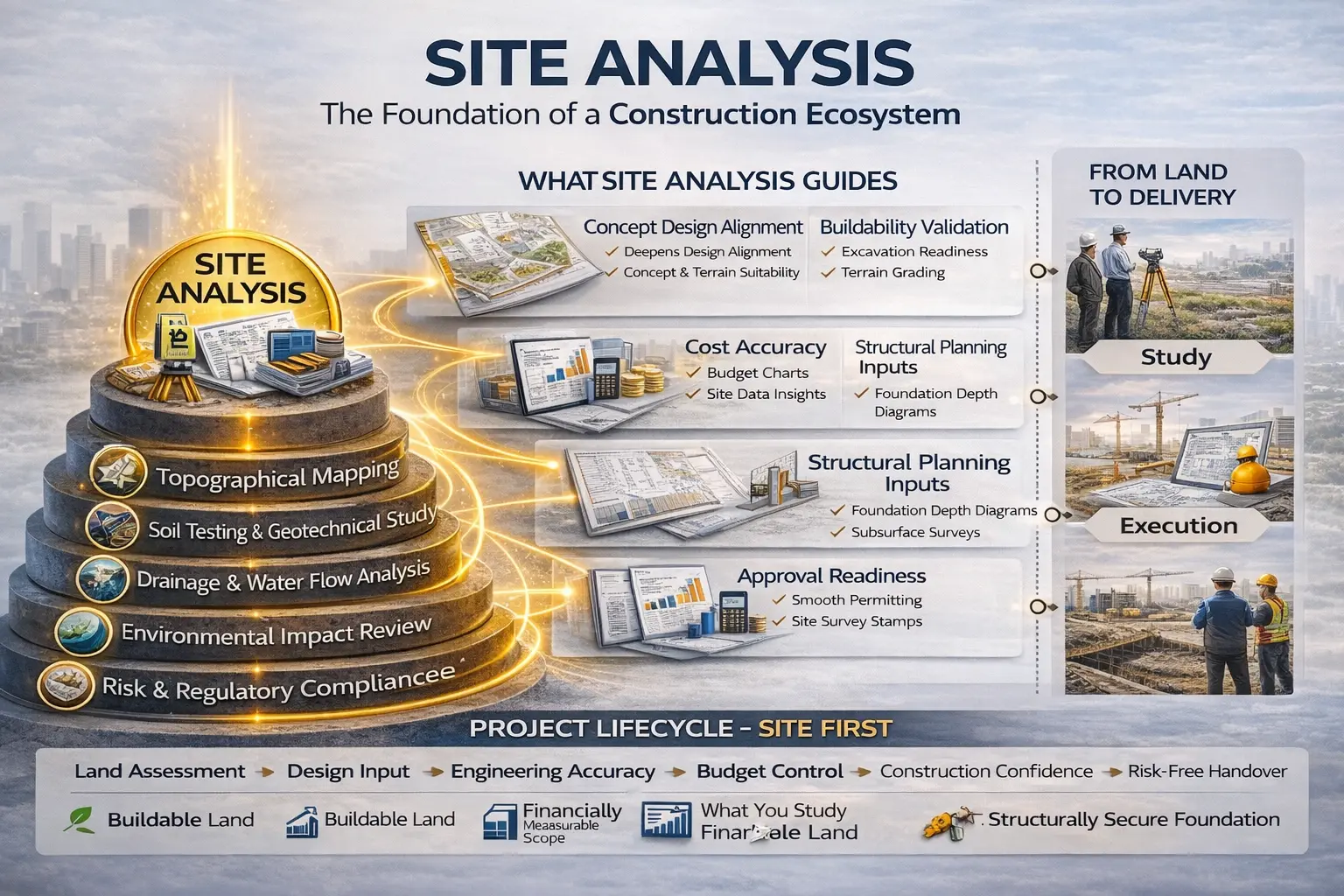
Without structured concept planning, your project faces layout inefficiencies, regulatory conflicts, structural redesign, cost escalation, and coordination gaps. When early decisions lack validation, you spend more time correcting drawings, revising approvals, and adjusting budgets. Capital exposure increases before execution even begins.
Concept Design and Planning Services establish clarity at the foundation level. You define spatial organization with clear zoning logic. You align layouts with regulatory limits such as setbacks, height controls, and FAR or FSI boundaries. Structural feasibility integrates from the start, ensuring column grids, load paths, and service zones support the proposed layout. Infrastructure compatibility is reviewed early, preventing utility conflicts during construction. Cost predictability improves because built up areas and system requirements are evaluated before detailed design.
You convert abstract vision into structured execution strategy. You move forward with clarity, alignment, and control.
We define public zones, private areas, service corridors, circulation paths, and utility networks with operational logic. Each space supports movement efficiency and user experience. You reduce congestion and coordination issues. Structural and service systems align with layout decisions early.
We study building form, height proportion, footprint efficiency, and volumetric balance. You evaluate scale realism and structural feasibility before detailed drawings begin. Sunlight exposure, ventilation behavior, and urban context inform form decisions. Early validation prevents scale mismatch during approvals.
We test the concept against setbacks, FAR or FSI limits, height controls, fire norms, environmental rules, and zoning classification. You design within statutory boundaries from day one. Approval risk reduces. Redesign cycles decrease.
We align layout decisions with foundation strategy, load distribution logic, service shafts, utility routing, and infrastructure capacity. Structural systems and MEP coordination integrate early. You prevent disconnect between design intent and engineering feasibility.
We connect concept scale with cost benchmarks. Built up area, material direction, and infrastructure demand are reviewed against capital capacity. You maintain financial discipline. Scope expansion remains controlled. ROI projections stay grounded in realistic assumptions.
For multi stage projects, we define structured expansion models. Core systems and infrastructure networks support future growth without disruption. You protect long term flexibility while maintaining execution stability and capital control.
We plan beyond immediate construction. Concepts incorporate expansion capacity, infrastructure scalability, and phased growth models. Vertical extension, horizontal growth, or mixed use integration align with foundational systems. You protect long term flexibility without disrupting operations.
Your concept transitions directly into architectural drawings, structural frameworks, MEP layouts, budgeting models, and project schedules. Continuity exists between planning and execution. What you approve at concept stage carries forward into construction with clarity and coordination.
We do not create sketches without structure.
You receive strategic development direction within an integrated construction ecosystem.
Every project begins with deep planning, accurate execution, and structural integrity that lasts for decades.
We combine contemporary engineering methods, smart materials, and clean design to deliver future-ready spaces.
From raw materials to finishing details, we follow strict quality standards at every stage of construction.
Clear communication, honest timelines, and cost transparency — no hidden surprises.